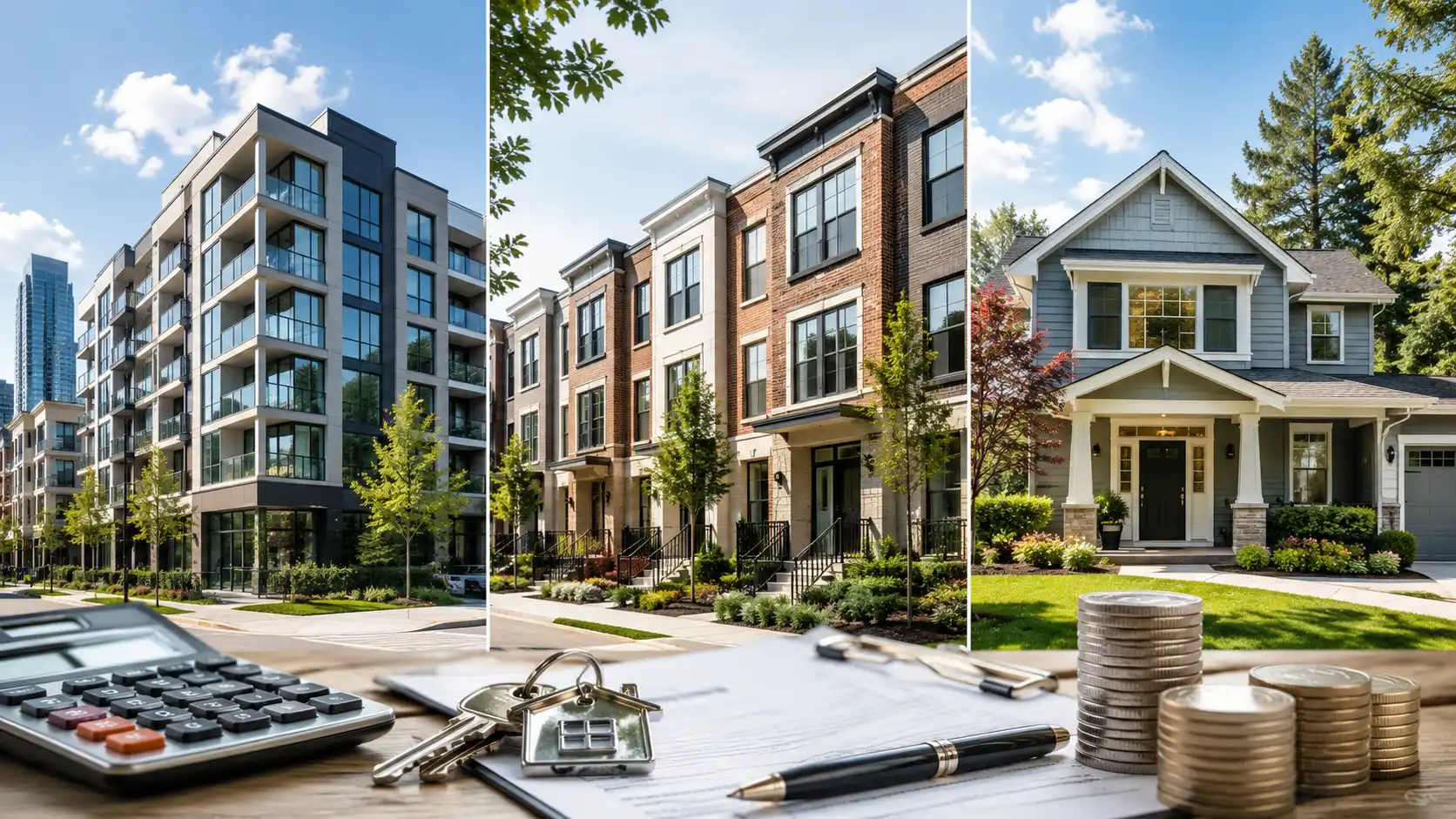
Buyers narrow by price, location, and bedrooms. Property type is usually treated as a preference.
From a lending standpoint it is not a preference. It changes what you qualify for, how long approval takes, and in some cases whether financing is available at all.
Single-family is the baseline
Every program is built around it. Guidelines are the most flexible, the approval depends almost entirely on you and the property’s value, and there is no third party whose finances affect your loan.
Everything below is a variation on this.
Condos: the building gets approved too
Here is what surprises people. On a condo, the lender underwrites the association, not just you.
Reviewers look at the association’s budget and reserve funding, its insurance coverage, what percentage of units are owner-occupied versus rented, whether any single entity owns too large a share of the building, whether dues are widely delinquent, and whether the association is involved in litigation.
A building that fails these tests is called non-warrantable. You can be a flawless borrower and still be unable to finance a unit there conventionally.
Non-warrantable condo financing exists through specialty lenders, and it generally requires more down payment and carries different terms. It is a solution, not a free pass.
The practical advice: before you get attached to a unit, ask whether the building is warrantable. Your agent can request the association’s documents. Finding this out after you are under contract is a genuinely bad week.
HOA dues count against you
This is the affordability piece buyers miss.
Monthly HOA or condo dues are added to your housing payment for qualifying purposes, exactly like taxes and insurance.
Consider two hypothetical properties at the same price. One is a single-family home. The other is a condo with $500 monthly dues. The condo buyer’s qualifying payment is $500 higher, which means they qualify for a smaller loan at the same income.
Dues can also rise, and a special assessment for a roof or a facade repair can arrive with little warning. Ask about planned assessments and reserve levels before you buy, not after.
Townhouses depend on how they are titled
Townhouse describes a style of construction, not a form of ownership. Two identical-looking townhouses can be financed very differently.
If the unit is titled as a fee simple property where you own the land beneath it, it is generally financed as a single-family home even with an HOA attached.
If it is titled as a condominium, it gets condo treatment including the warrantability review, regardless of what it looks like.
Ask how a property is titled. Do not assume from the listing photos.
Co-ops are their own category
Less common in North Jersey than across the river, but they exist.
In a co-op you own shares in a corporation rather than real property, which means financing works differently and fewer lenders participate. There is also typically a board approval process separate from and in addition to your mortgage approval, and the board can decline you for its own reasons.
If you are considering a co-op, confirm financing availability before you invest time in it.
Ask before you fall in love
Property type questions are easy to answer early and expensive to discover late.
Send us a listing you are considering and we will tell you what the financing looks like for that specific property, including whether the building is likely to pass review.
Trinity Lending Company | NMLS #2762052 | Equal Housing Opportunity